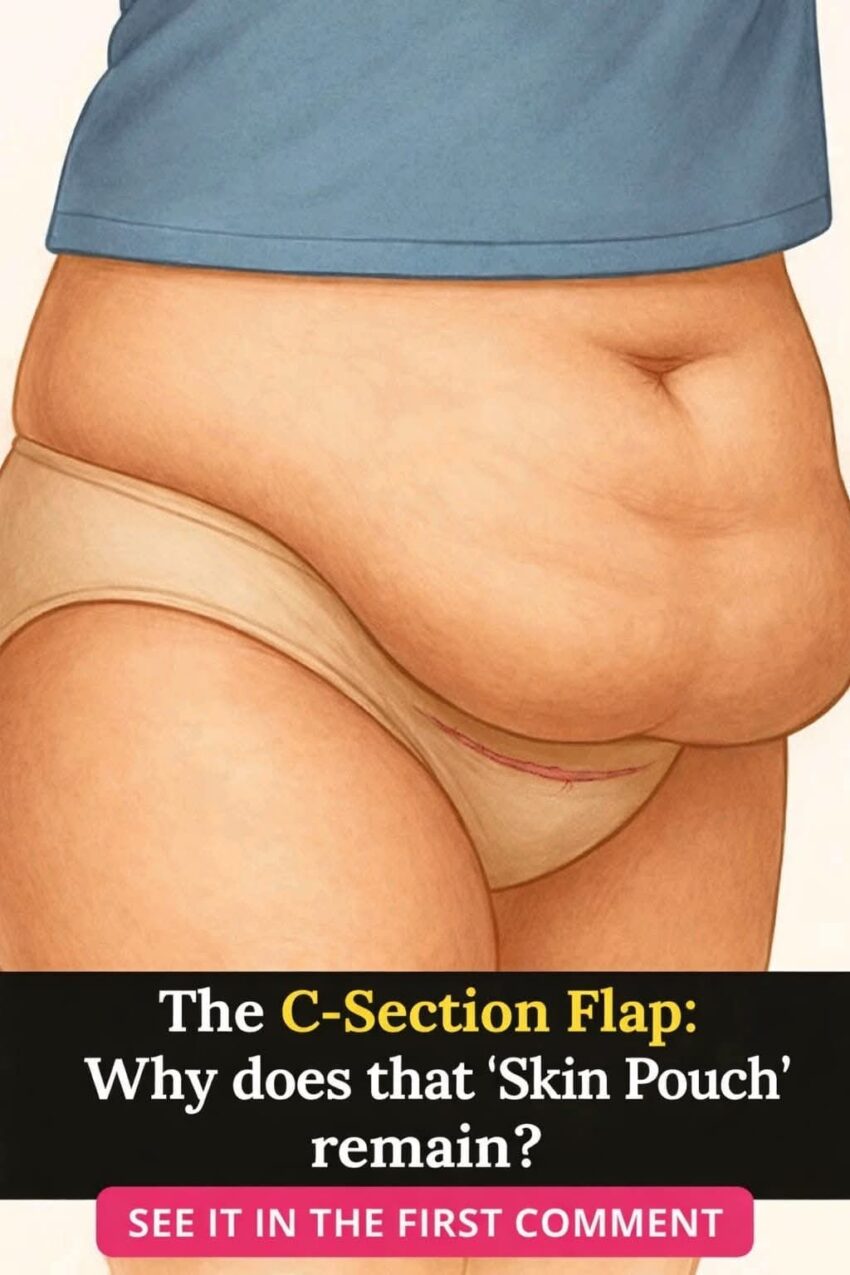
That “bag” or flap of skin after a Cesarean section (C-section) is very common—and it has a real anatomical explanation. It’s often informally called a “C-section shelf” or “pooch,” and it’s not just about weight gain.
Why it happens
1. Skin and tissue stretching
During pregnancy, your abdomen stretches significantly to accommodate the baby. After delivery, the skin and underlying tissue don’t always snap back completely, especially if:
- The skin lost elasticity
- There was significant stretching (larger baby, multiple pregnancies)
2. Surgical incision effects
A Cesarean section involves cutting through multiple layers:
- Skin
- Fat
- Fascia (connective tissue)
When these layers heal, the scar can:
- Adhere to deeper tissues
- Create a slight “ledge” above the incision
This makes the area above the scar look like it hangs or bulges.
3. Fat distribution changes
Hormonal shifts during and after pregnancy encourage fat storage around the lower abdomen. Even with weight loss, this area can be stubborn.
4. Muscle separation (diastasis recti)
Many women develop Diastasis recti, where the abdominal muscles separate. This weakens core support and can push the belly outward, worsening the appearance of a flap.
5. Scar tissue and healing pattern
Scar tissue is less flexible than normal skin. Depending on healing:
- The scar may pull inward
- The upper area may appear to “overhang”
Important reality check
This flap is:
- Normal
- Not a sign of failure to “bounce back”
- Often partly structural, not just fat
Even very fit people can have it.
Can it go away?
It depends on the cause:
- Fat-related:
Can improve with overall fat loss (diet + exercise) - Muscle separation:
Targeted core rehab (especially deep core exercises) can help - Skin & scar-related:
Harder to fully reverse without medical procedures
What can help
- Core rehabilitation (especially for diastasis recti)
- Strength training (not just crunches—focus on deep core)
- Scar massage / physiotherapy (to reduce adhesion)
- Patience—healing can take months to years
In some cases, people consider:
- Cosmetic procedures (like scar revision or abdominoplasty)
Bottom line
That “C-section flap” isn’t just fat—it’s a mix of skin elasticity, scar formation, fat distribution, and muscle changes. For many, it’s simply a long-term physical reminder of major abdominal surgery and pregnancy.
If you want, I can break down exercises that actually help vs. ones that make it worse, or explain how to tell if diastasis recti is contributing.
