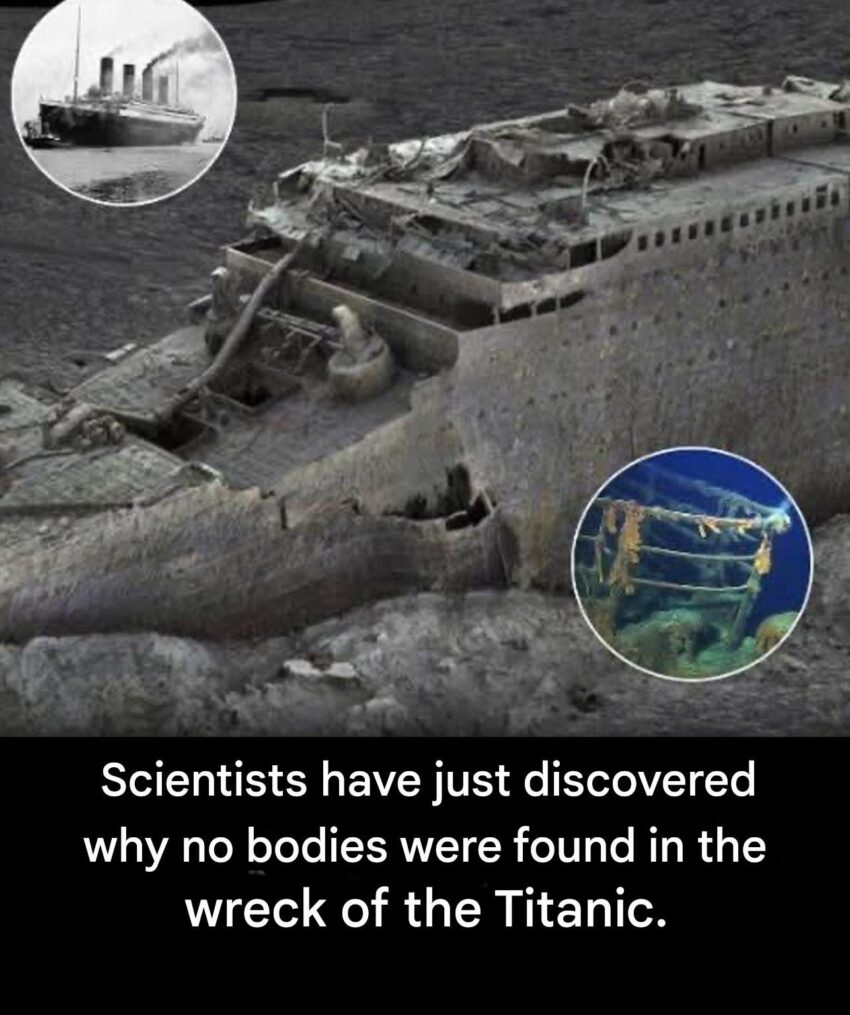
Here’s what scientists and deep‑sea experts actually say about why no human bodies or skeletons have ever been found at the wreck of the Titanic — and it isn’t a hidden mystery or recent “discovery,” but a result of real ocean science and the environment where the ship lies. (The Environmental Literacy Council)
🚢 1. Most Bodies Were Never at the Wreck Site
When the Titanic sank in 1912, many victims were wearing life jackets that kept their bodies afloat for some time. Those bodies that didn’t float were generally dispersed widely by ocean currents long before the wreck was discovered. (iflscience.com)
Rescue ships recovered several hundred bodies from the surface in the days and weeks after the sinking, but many were never recovered at all — and those that sank didn’t necessarily stay at the wreck site. (iflscience.com)
🌊 2. The Deep Ocean *Doesn’t Preserve Bodies Like Land Burials
The Titanic rests about 12,500 feet (3,800 meters) below the surface — a depth where:
🧪 Calcium Carbonate Dissolves
Below a certain depth (the “calcium carbonate compensation depth”), seawater is undersaturated in calcium carbonate — a key component of bones.
At these depths, exposed bones gradually dissolve back into the water after soft tissue is eaten by scavengers. (iflscience.com)
🦐 Scavengers and Microbes Eat Organic Material
Deep‑sea scavengers like crustaceans and hagfish — and microbes adapted to cold, high‑pressure water — efficiently consume flesh. Once soft tissue is gone, bones become vulnerable to chemical and microbial degradation, leaving little trace. (The Environmental Literacy Council)
🌡️ Cold, High Pressure + Currents
Although cold temperatures slow some decomposition, the intense pressure and continuous water movement actually help chemical breakdown processes that wouldn’t happen on land. (The Environmental Literacy Council)
🧐 3. Comparisons With Other Shipwrecks
People sometimes wonder why older or shallower wrecks (like the Vasa or Mary Rose) still contain bones. The difference is that those sinks occurred in shallower, lower‑pressure, fresher or less corrosive environments, where bones can persist longer. At Titanic’s depth, the chemical conditions don’t favor bone preservation. (iflscience.com)
🦶 4. What Has Been Seen at the Wreck
Explorers and deep‑sea cameras have found:
- Pairs of shoes or clothing remnants, where bodies once were, because leather and fabric can persist longer than bone.
- No confirmed human skeletons or recognizable bones. (Wikipedia)
🧠 The Bottom Line
So, the reason no bodies or skeletons have been found in the Titanic wreck isn’t due to secrecy or some new “scientific discovery” hidden from the public — it’s because:
- Many bodies were never at the wreck site to begin with. (iflscience.com)
- The deep‑sea environment destroys soft tissue rapidly. (The Environmental Literacy Council)
- The chemistry of deep ocean water dissolves bones over decades. (iflscience.com)
The wreck remains a powerful memorial to those who perished, even if their remains are no longer physically present on the seafloor. (The Environmental Literacy Council)
If you’d like, I can explain how scientists study deep‑sea decomposition and what other shipwrecks tell us about preservation—or why certain wrecks do still have human remains. Just let me know!
